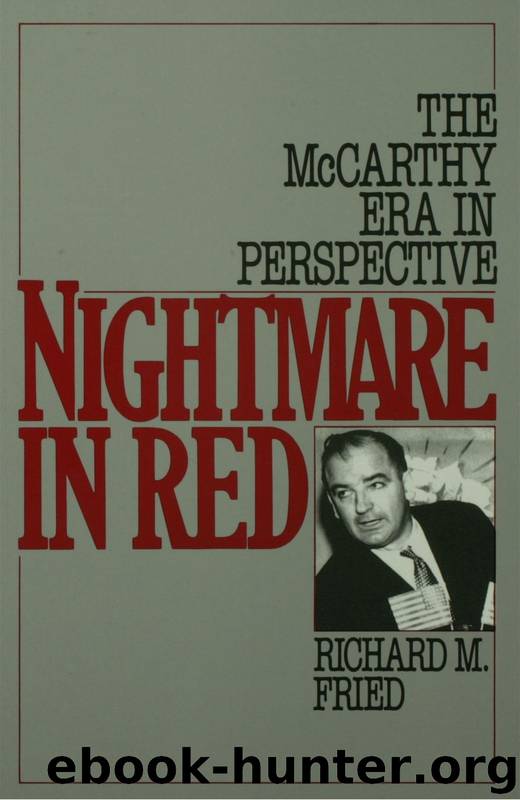
Nightmare In Red by Richard M. Fried
Author:Richard M. Fried [Fried, Richard M.]
Language: eng
Format: epub
Publisher: Oxford University Press
Published: 1990-12-26T06:00:00+00:00
6
“Bitter Days”
The Heyday of Anti-Communism
EVEN independent of McCarthy, the years 1950–1954 marked the climax of anti-communism in American life. The Korean stalemate generated both a bruising debate over containment and a sourness in national politics. Korea’s sapping effect and a series of minor scandals heightened the Democratic Party’s anemia. In addition, the 1950 congressional campaign, revealing McCarthyism’s apparent sway over the voters and encouraging the GOP’s right wing, signaled that anti-communism occupied the core of American political culture. “These,” said liberal commentator Elmer Davis in January 1951, “are bitter days—full of envy, hatred, malice, and all uncharitableness.”1
Critics of these trends in American politics had scant power or spirit. Outside government, foes of anti-Communist excesses moved cautiously lest they be redbaited and rarely took effective countermeasures. Liberals seldom strayed from the safety of the anti-Communist consensus. Radicals met the hostility of the dominant political forces in Cold War America and fared poorly. In government, anti-communism ruled. Senate resistance to McCarthy was scattered and weak. In the House, HUAC did much as it pleased. Truman upheld civil liberties with occasional eloquence, but he remained on the defensive, and his Justice Department often seemed locked in near-alliance with the Right in Congress. Eisenhower, when not appeasing the McCarthyites, appeared at times no more able to curb them than had Truman.
Even at his peak, McCarthy was not the sole anti-Communist paladin, though he cultivated that impression. As McCarthyism in its broader sense outlived the personal defeat of McCarthy himself, so, in its prime, it exceeded his reach. Its strength owed much to the wide acceptance, even by McCarthy’s critics, of the era’s anti-Communist premises. Along with McCarthy, they made the first half of the 1950s the acme of noisy anti-communism and of the ills to which it gave birth.
Soon after the 1950 campaign, skirmishing over the Communist issue renewed in earnest. In December Senator Pat McCarran joined the hunt for subversives by creating the Senate Internal Security Subcommittee (SISS). As chairman of that panel (and the parent Judiciary Committee), the crusty Nevada Democrat packed it with such like-minded colleagues as Democrats James Eastland and Willis Smith and Republicans Homer Ferguson and William Jenner. While McCarthy darted about unpredictably, McCarran moved glacially but steadily to his objective, crushing opposition.
McCarran’s panel spotlighted themes that McCarthy had raised giving them a more sympathetic hearing than had the Tydings Committee. In February 1951, federal agents swooped down on a barn in Lee, Massachusetts, seized the dead files of the Institute of Pacific Relations (IPR) and trucked them under guard to Washington. After sifting this haul, a SISS subcommittee opened an extended probe of the IPR, which led to a new inquest on “who lost China” and resulted in renewed loyalty and security proceedings, dismissals from the State Department and prosecution—all to McCarthy’s greater, reflected glory.
The subcommittee acquired a reputation—more cultivated than deserved—for honoring due process. SISS was punctilious on some points: evidence was formally introduced (when an excerpt was read, the full text was put in the record);
Download
This site does not store any files on its server. We only index and link to content provided by other sites. Please contact the content providers to delete copyright contents if any and email us, we'll remove relevant links or contents immediately.
| Africa | Americas |
| Arctic & Antarctica | Asia |
| Australia & Oceania | Europe |
| Middle East | Russia |
| United States | World |
| Ancient Civilizations | Military |
| Historical Study & Educational Resources |
Cat's cradle by Kurt Vonnegut(15362)
Pimp by Iceberg Slim(14516)
4 3 2 1: A Novel by Paul Auster(12397)
Underground: A Human History of the Worlds Beneath Our Feet by Will Hunt(12100)
The Radium Girls by Kate Moore(12033)
Wiseguy by Nicholas Pileggi(5791)
The Fire Next Time by James Baldwin(5452)
Perfect Rhythm by Jae(5409)
American History Stories, Volume III (Yesterday's Classics) by Pratt Mara L(5309)
Paper Towns by Green John(5194)
Pale Blue Dot by Carl Sagan(5012)
A Higher Loyalty: Truth, Lies, and Leadership by James Comey(4965)
The Mayflower and the Pilgrims' New World by Nathaniel Philbrick(4506)
The Doomsday Machine by Daniel Ellsberg(4492)
Killers of the Flower Moon: The Osage Murders and the Birth of the FBI by David Grann(4449)
The Sympathizer by Viet Thanh Nguyen(4396)
Too Much and Not the Mood by Durga Chew-Bose(4349)
The Borden Murders by Sarah Miller(4328)
Sticky Fingers by Joe Hagan(4204)
